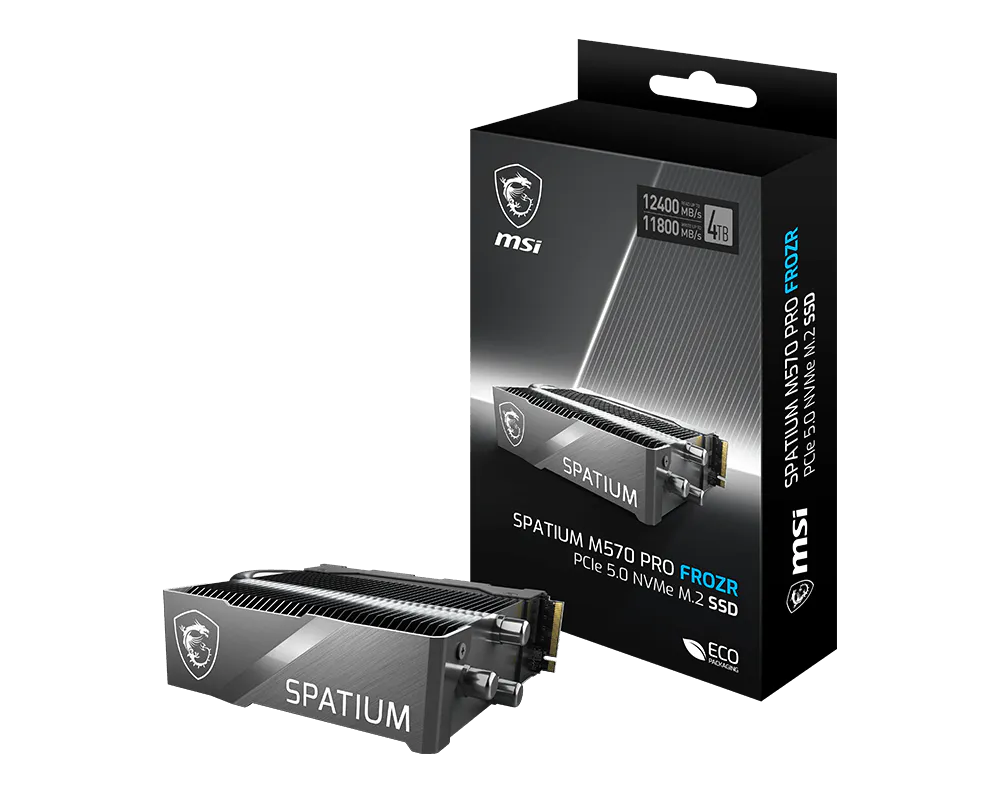
SPATIUM M570 PRO PCIe 5.0 NVMe M.2 FROZR
| Differences are marked in red | SPATIUM M570 PRO PCIe 5.0 NVMe M.2 FROZR 1TB | SPATIUM M570 PRO PCIe 5.0 NVMe M.2 FROZR 2TB | SPATIUM M570 PRO PCIe 5.0 NVMe M.2 FROZR 4TB |
|---|---|---|---|
| Model Name | SPATIUM M570 PRO PCIe 5.0 NVMe M.2 FROZR | SPATIUM M570 PRO PCIe 5.0 NVMe M.2 FROZR | SPATIUM M570 PRO PCIe 5.0 NVMe M.2 FROZR |
| Capacity | 1TB | 2TB | 4TB |
| Controller | PHISON E26 | PHISON E26 | PHISON E26 |
| Flash Memory | 3D NAND | 3D NAND | 3D NAND |
| DRAM Cache | 2GB LPDDR4 | 4GB LPDDR4 | 8GB LPDDR4 |
| Form Factor | M.2 2280 | M.2 2280 | M.2 2280 |
| Interface | PCIe Gen5x4, NVMe 2.0 | PCIe Gen5x4, NVMe 2.0 | PCIe Gen5x4, NVMe 2.0 |
| Compatibility | PCIe Gen5 / Gen4 / Gen3 / Gen2 / Gen1 | PCIe Gen5 / Gen4 / Gen3 / Gen2 / Gen1 | PCIe Gen5 / Gen4 / Gen3 / Gen2 / Gen1 |
| Dimensions | 94.80mm (L) x 24.00mm (W) x 71.65mm (H)<br /> Recommended installation space: up to 22 x 110 mm available | 94.80mm (L) x 24.00mm (W) x 71.65mm (H)<br /> Recommended installation space: up to 22 x 110 mm available | 94.80mm (L) x 24.00mm (W) x 71.65mm (H)<br /> Recommended installation space: up to 22 x 110 mm available |
| Sequential Read up to (MB/s) | 11,700 | 12,400 | 12,400 |
| Sequential Write up to (MB/s) | 9,500 | 11,800 | 11,800 |
| Maximum Operating Power (W) | 11 | 11.5 | 11.5 |
| Idle Power PS3 (mW) | 144 | 144 | 144 |
| Low Power L1.2 (mW) | 85 | 85 | 85 |
| Operating Temperatures | 0°C – 70°C | 0°C – 70°C | 0°C – 70°C |
| Storage Temperatures | -40°C – 85°C | -40°C – 85°C | -40°C – 85°C |
| Terabytes Written (TBW) | 700 | 1400 | 3000 |
| Mean Time Between Failure (MTBF) | Up to 1,600,000 Hours | Up to 1,600,000 Hours | Up to 1,600,000 Hours |
| Limited Warranty | 5 Years, or the coverage for the maximum TBW as stated, whichever comes first. | 5 Years, or the coverage for the maximum TBW as stated, whichever comes first. | 5 Years, or the coverage for the maximum TBW as stated, whichever comes first. |
| Advanced Features | TRIM (Performance Optimization, OS Support required)<br /> SMART (Self-Monitoring, Analysis and Reporting Technology)<br /> LDPC (Low Density Parity Check) ECC Algorithm<br /> End to End Data Path Protection<br /> APST (Autonomous Power State Transition)<br /> AES256/OPAL 2.0 (Encryption, Data Security) | TRIM (Performance Optimization, OS Support required)<br /> SMART (Self-Monitoring, Analysis and Reporting Technology)<br /> LDPC (Low Density Parity Check) ECC Algorithm<br /> End to End Data Path Protection<br /> APST (Autonomous Power State Transition)<br /> AES256/OPAL 2.0 (Encryption, Data Security) | TRIM (Performance Optimization, OS Support required)<br /> SMART (Self-Monitoring, Analysis and Reporting Technology)<br /> LDPC (Low Density Parity Check) ECC Algorithm<br /> End to End Data Path Protection<br /> APST (Autonomous Power State Transition)<br /> AES256/OPAL 2.0 (Encryption, Data Security) |
All images and descriptions are for illustrative purposes only. Visual representation of the products may not be perfectly accurate. Product specification, functions and appearance may vary by models and differ from country to country . All specifications are subject to change without notice. Please consult the product specifications page for full details.Although we endeavor to present the most precise and comprehensive information at the time of publication, a small number of items may contain typography or photography errors. Products may not be available in all markets. We recommend you to check with your local supplier for exact offers.